

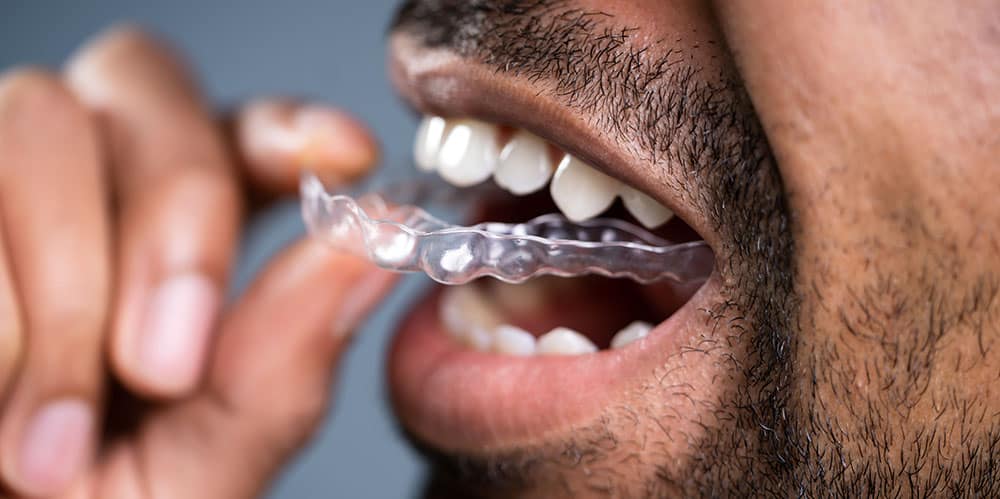
Clear aligners, like Invisalign, are a modern orthodontic solution for straightening teeth. These custom-made, transparent plastic trays fit snugly over the teeth to gradually shift them into a more desirable position. As an alternative to traditional metal braces, they offer a different approach to achieving orthodontic goals. Here’s more information on Invisalign and traditional braces treatments:
Adjusting Tooth Alignment Precisely
Both Invisalign and traditional braces work by applying consistent, controlled force to the teeth to guide them into proper alignment. Traditional braces use brackets bonded to each tooth and connected by an archwire; an orthodontist periodically tightens this wire to create the necessary tension for tooth movement. This traditional system is highly effective for a wide range of orthodontic adjustments.
Invisalign uses a series of progressive clear aligners. Each set is worn for approximately one to two weeks before being replaced by the next in the series, and each new tray is shaped slightly differently to continue the gentle shifting process. While braces are fixed in place for the duration of the orthodontic treatment, Invisalign aligners are removable. This means clear aligners must be worn for 20 to 22 hours a day for effective results.
Correcting Bite and Functional Issues
Beyond cosmetic straightening, orthodontic treatments often address functional concerns related to bite alignment. The suitability of Invisalign aligners depends on the specific issues present. For many individuals with mild to moderate alignment problems, clear aligners can be a successful treatment option, as this technology can manage specific types of tooth movement.
Clear aligners are frequently used to correct several common dental alignment issues, including:
- Gapped Teeth
- Crowded Teeth,
- Certain Bite Irregularities (Like Overbites, Underbites, and Crossbites)
In certain complex orthodontic cases, traditional braces may be a more appropriate recommendation. Situations involving severe bite problems, significant tooth rotation, or the need to move teeth vertically may require the force and mechanics that only fixed braces can provide. Braces offer the orthodontist greater control for intricate and substantial adjustments, making them the preferred choice for more complex treatment plans.
Impacting Daily Oral Hygiene
One distinct aspect of Invisalign treatment is its impact on daily oral hygiene routines. Because the aligners are removable, they can be taken out for eating, drinking, brushing, and flossing. This allows an individual to maintain their normal oral hygiene practices without needing to navigate around brackets and wires. Having clear aligners requires discipline, as aligners must be cleaned regularly, and teeth must be brushed after every meal before reinserting the trays to maintain oral health.
Learn More About Invisalign
Invisalign treatment offers a method for straightening teeth that differs from traditional braces, providing a less visible and more flexible option for many individuals. It is effective for a range of alignment issues, though complex cases may still require the mechanics of conventional braces. The removable nature of the aligners simplifies oral hygiene, but it also demands consistent patient compliance for the treatment to be successful. If you are interested in orthodontic corrections of your teeth, contact an orthodontic specialist to schedule a consultation today.